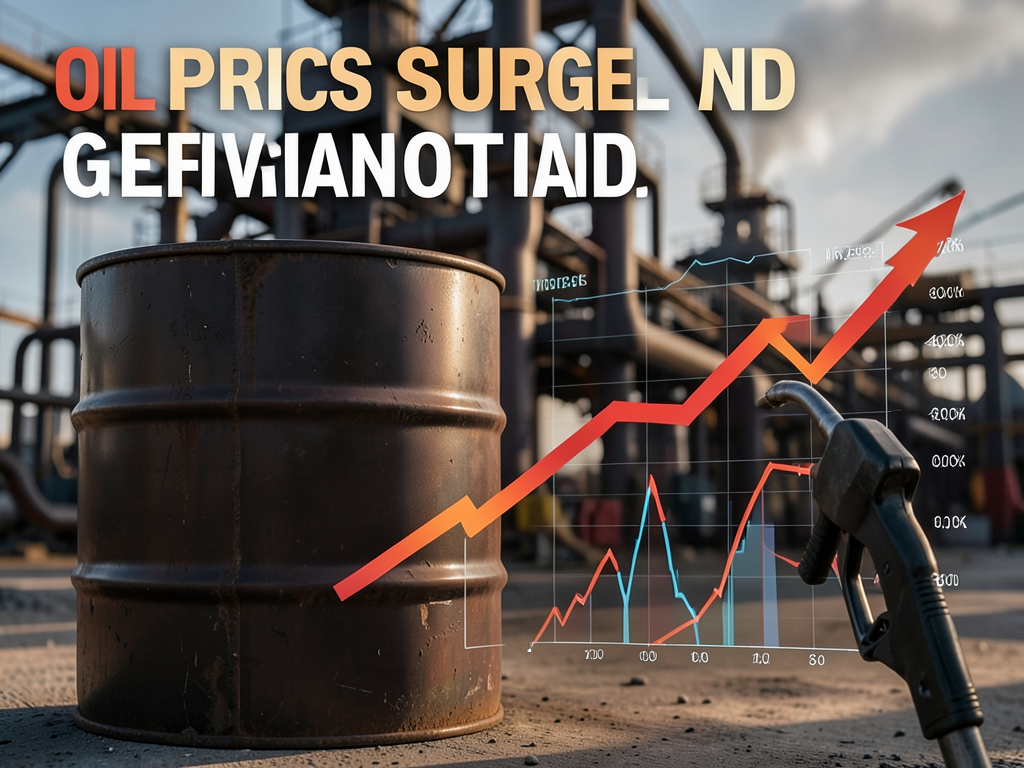
Oil markets jumped sharply on Monday after a series of drone attacks in the Gulf region reignited fears of a major supply crisis, a development that could send fuel prices soaring across Pakistan and derail the country’s efforts to control inflation.
Brent crude climbed 1.2 percent to reach $110.63 per barrel, while US benchmark West Texas Intermediate rose 1.0 percent to $106.42. The spike followed a drone strike that ignited a fire at a nuclear power plant in the United Arab Emirates, while Saudi Arabia reported intercepting three separate drones targeting its territory.
US President Donald Trump issued a stern warning to Iran, urging Tehran to move quickly toward a negotiated settlement. The escalating tensions come as Iran tightens its grip on the Strait of Hormuz, the narrow waterway that normally handles roughly one-fifth of the world’s oil trade. Shipping through the strait has been severely disrupted, and analysts warn that global oil inventories are being depleted at an alarming rate.
According to Capital Economics, if the strait remains closed, global oil stockpiles could hit critical levels by the end of June. The firm projects Brent crude could surge to between $130 and $140 per barrel, with some scenarios pushing prices as high as $150 into 2027. Such a spike would drive inflation in major economies to nearly 10 percent and likely trigger a global recession.
For Pakistan, the implications are immediate and severe. The country imports the vast majority of its oil and relies heavily on fuel for transportation, electricity generation, and industry. A sustained rise in crude prices would push up petrol and diesel costs at the pump, increase electricity tariffs, and raise the cost of goods across the board. This would hit household budgets hard and complicate the government’s ongoing battle to bring down inflation, which has already strained the economy and eroded purchasing power.
The conflict between the United States, Israel, and Iran has been ongoing since late February, when major military strikes were launched against Iranian targets. Tehran responded by effectively shutting down the Strait of Hormuz, cutting off a vital artery for global energy supplies. More than 1 billion barrels of oil have already been lost due to the disruption, according to analysts at Eurasia Group, who expect prices to remain elevated for the rest of the year.
Rising energy costs are also rattling financial markets. US Treasury yields climbed sharply last week, with the 10-year yield reaching 4.584 percent and the 30-year yield hitting 5.109 percent. Stock markets in Asia fell on Monday, with Japan’s Nikkei down 0.4 percent and South Korea’s market dropping 2.1 percent. US stock futures also declined in early trading.
G7 finance ministers are meeting in Paris on Monday to discuss the crisis and coordinate responses to the supply chain disruptions. The gathering comes as geopolitical divisions threaten to undermine international unity on energy security and critical raw materials.
Corporate earnings reports are beginning to reflect the economic toll of the conflict. A Reuters analysis found that at least 279 companies worldwide have cited the war as a reason for defensive measures, including price increases, production cuts, and staff furloughs. The total cost to businesses has already exceeded $25 billion, with airlines bearing the brunt of the impact due to soaring jet fuel prices.
Toyota has warned of a $4.3 billion hit, while Procter & Gamble estimates a $1 billion blow to post-tax profits. Fast-food chains and consumer goods companies are also feeling the pressure, as higher fuel costs squeeze lower-income consumers and dampen demand.
For Pakistan, the stakes are high. The country is already grappling with economic challenges, including a heavy debt burden, a weak currency, and limited foreign exchange reserves. A prolonged period of elevated oil prices would worsen the trade deficit, increase the cost of debt servicing, and put additional pressure on the rupee. It would also make it harder for the government to provide relief to citizens already struggling with high living costs.
Analysts warn that if the conflict drags on and oil prices remain elevated, Pakistan could face a difficult choice between subsidizing fuel to protect consumers or allowing prices to rise and risking social unrest. Either option would strain public finances and complicate efforts to meet targets set by international lenders.
The situation remains fluid, with little sign of a breakthrough in negotiations. Trump has indicated he does not expect to need China’s help to resolve the conflict, even as hopes for a lasting ceasefire have faded. Meanwhile, Iran continues to assert control over the Strait of Hormuz, and the risk of further escalation remains high.
For now, Pakistani consumers and businesses should brace for higher fuel costs and the ripple effects that will follow. The coming weeks will be critical in determining whether the crisis can be contained or whether the world is heading toward a prolonged period of energy insecurity and economic turbulence.